Stanford CS101 Introduction : Lecture 1
Stanford CS101 Introduction
Nick Parlante - Stanford University (Nick's Home Page)
This class explores the essential qualities of computers, how they work, what they can and cannot do, and requires no computer background at all.
Acknowledgements: thanks to Google for supporting my early research that has helped me create this class.
Format note: Video + Document
Fundamental Equation of Computers
The fundamental equation of computers is:
Computer = Powerful + Stupid
- Computers are very powerful, looking through large amounts of data quickly. Computers can literally perform billions of operations per second.
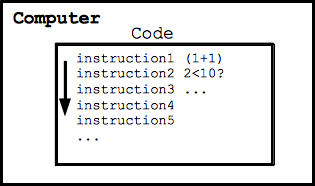
- However, the individual "operations" that computers can perform are extremely simple and mechanical, nothing like a human thought or insight. A typical operation in the language of computers is adding two numbers together.
- So although the computers are fast at what they do, the operations that they can do are extremely rigid, simple, and mechanical. The computer lacks anything like real insight. Or put another way, computers are not like the HAL 9000 from the movie 2001: A Space Odyssey.
- If nothing else, you should not be intimidated by the computer as if it's some sort of brain. The computer is a mechanical tool which can do amazing things, but it requires a human to tell it what to do.
High Level - How Does a Computer Work?
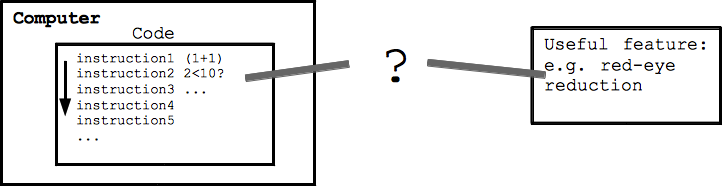
But So Many Useful Features
Programmers Make It Happen
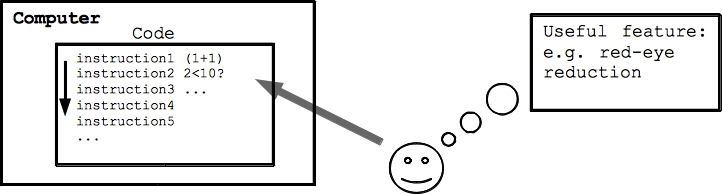
Since the computer is totally mechanical and stupid -- how do they manage to do so many useful things? The gap between the computer and doing something useful is where the human programmer creates solutions. Programming is about a person using their insight about what would be useful and how it could be done, and breaking the steps down into code the computer can follow.
Next: start with code
Comments
Post a Comment